
Careful returns
Memory games

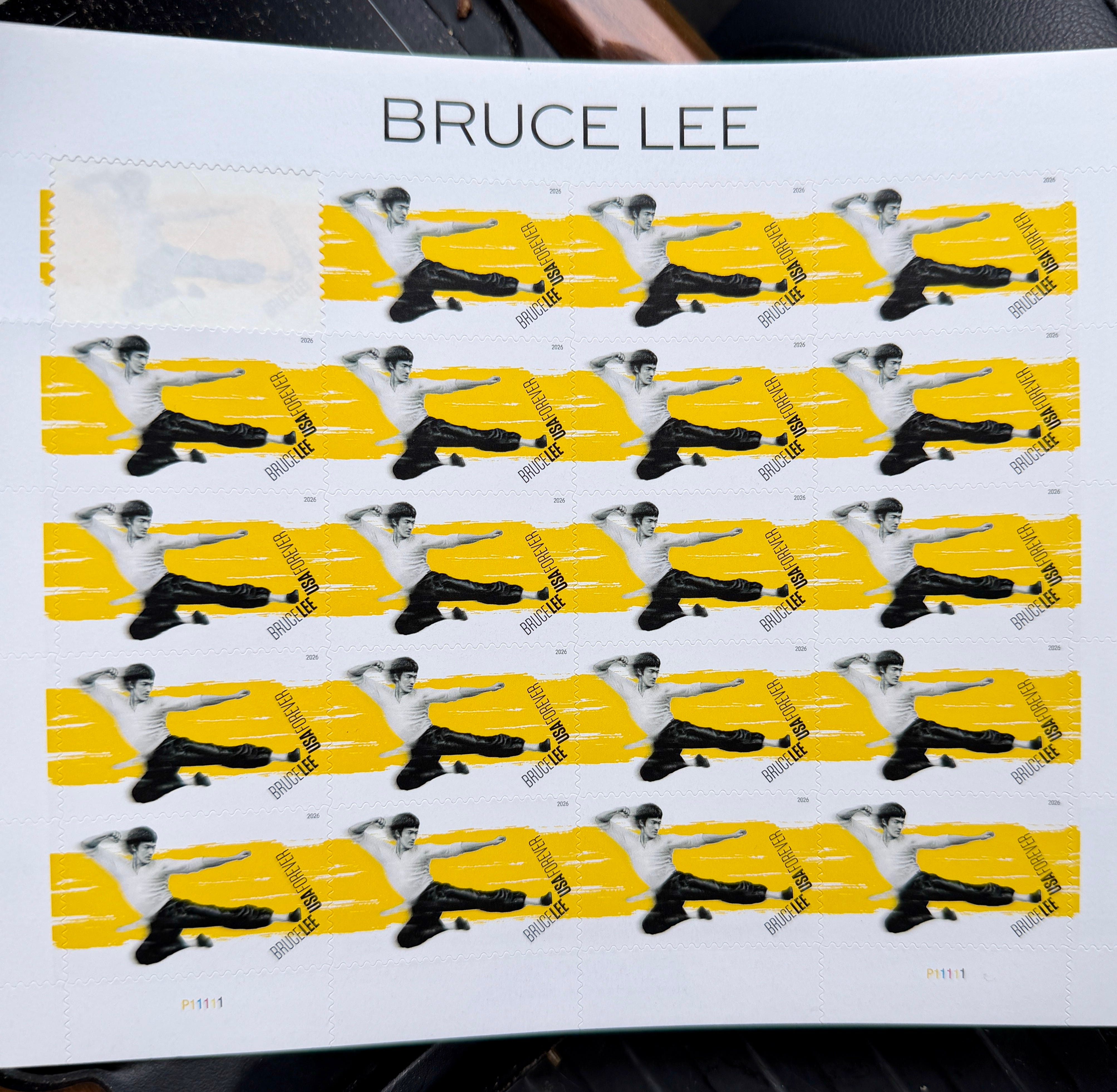
Bruce Lee postage stamps, available at USPS
Inching toward the middle of the spring semester I’m going to go ahead and call it the most chaotic one since COVID began.
I woke up at 4:30 this morning. The only way I’m able to write is by stealing some extra time between blizzards, burst boilers, floods, and deep freezes. My son’s school has run out of snow days. He’s showing his coin collection to his 2nd grade class over Zoom in his bedroom, while I teach college students on Zoom from another room. I get the panicky feeling that my time is not my own, that I forgot something important; the increased mental load of constantly pivoting to meet new needs in order to accommodate for the general collapse of our institutions has become a feature of mothering in the winter of 2026.
Some ideas constellating around rigidity, fluidity, creativity and embodiment:
At age 20 figure skater Alysa Liu exuberantly returns to the sport she quit at 16, leaving behind rigid diets and achievement goals. The world beholds her unfettered joyful embodiment, which stuns the quippy announcers speechless. I watch with my son and burst into tears, “Mama! Don’t cry! OK, you can cry, but just a little bit.” The reverberations around her performance highlight the humanity of it all: you-know-it-when-you-see-it humanism. “That’s what I’m fuckin’ talking about!” we shout through our tears which suddenly encompass so much; Epstein, Gaza, ICE, the civil war inflaming our country, the ceaselessness of violence everywhere, the surreal mundanity of the day to day, the collapse of media and journalism, slopification of the internet…
In a destabilized world of fakes and pervasive doubt, Alysa Liu, Eileen Gu and all the other incredible female Olympic athletes are not and will never be AI.
Leif Weatherby’s ideas on “remainder humanism” and AI are really compelling.
In terms of a creative practice, Liu’s performance implicitly invites us to transform our internal boss from a stern task master to a nurturing figure, like a kind teacher, gently returning us to our embodied labor instead of scolding and shaming us for how we do it. This consistent, gentle return creates the conditions for joyful creativity, rigorously held by a flexible container. That container is our body and our relationship to it, but also our relationship to time and whatever our conceptual approach is to the activities that comprise our days. This is what I love about sports: athletes show us how to return. Our many returns make up most of our lives, whereas our wins and losses last mere moments.
Personally, I practice chaotic discipline. Some days I get a week’s worth of work done. Some days I barely achieve the most basic tasks. Other people’s ideas of a productive routine or even a creative practice have never worked for me.
I try to be the gentle hand returning me again and again to my heart’s tasks. It’s hard. It’s a muscle I exercise.
I’ve been teaching about John Cage in my sound art class. He points out that the root of the word “discipline” is “disciple.” An artist, therefore, is a disciple of her ideas. Often people think of it as the other way around.
It’s good to remember that we should be a disciple of the work not a victim of our inner disciplinarian, some internalized authoritarian monster from another time, likely from a past occasion of disempowerment at home or school.
Speaking of monsters, Douglas Rushkoff’s essay addressing how his name ended up in the Epstein files does an incredibly efficient job of drawing crystal clear lines between how philosophy rooted in anti-humanism and eugenics perpetuates extraction, colonialism and misogyny and the philosophers behind the development of those schools of thought were funded by Epstein. He paid for their dinners, he paid for the magazines that published them, and they in turn gave men permission to treat humans like objects. Rushkoff describes the recursion mirror in this house of horrors where we’re all living at the moment: visions of rape, murder and genocide are everywhere we look.
I found comfort in Ariana Reines’ audio post about the relationship between writing and memory, amongst the many other insights and connections she describes so eloquently. It reminded me that one of the many reasons I’ve been feeling so detached from myself, so disoriented about time, is that I haven’t been able to write as much as I need to in order to stay sane, to digest the century that happens each day, to remember who I am amidst it all. Yet, if I wake up at 4:30 every day to write I will feel bad in a different way. Sometimes it’s about choosing which flavor of bad is the most palatable. Or prioritizing your most basic physical needs.
The strength of my delight surprised me when I found Bruce Lee stamps at our local post office. I peeled off a tiny Bruce Lee, adhered him to the corner of the letter and imagined him kung-fu kicking my get-well-soon card all the way to my friend’s apartment. I just looked up whether Bruce Lee indeed practiced kung fu and learned that he actually broke away from rigid traditional kung fu to embrace a "style without style," which he called Jeet Kune Do, a fluid, combat-oriented martial arts philosophy focused on simplicity and speed. He made his own flexible container.
My qi gong teacher talks about how our bodies are comprised of so much water that it’s important to stay fluid, especially during the coldest times of the year, otherwise our energy freezes.
yes to all of this
🤍